
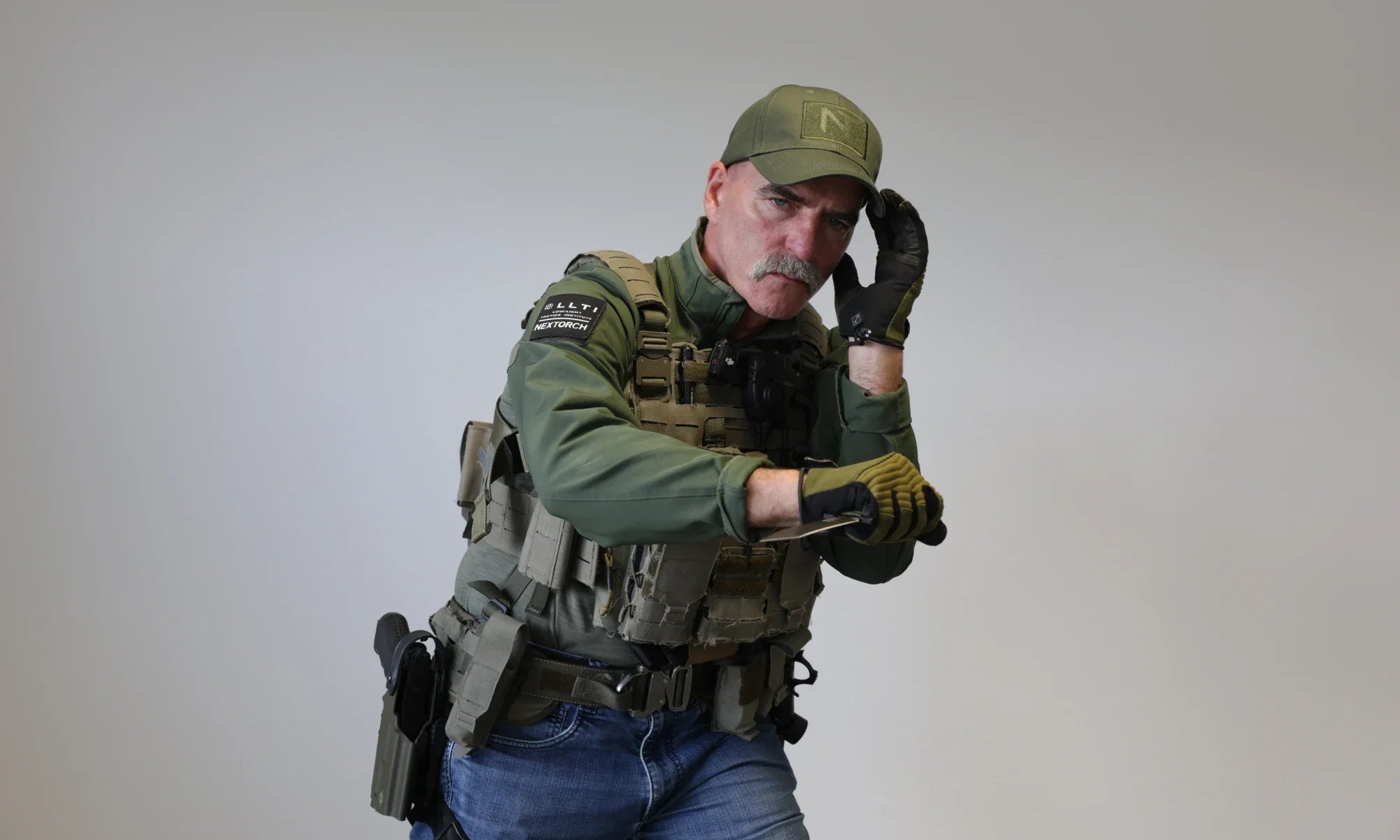
Hermann Rosenberg (“Rosi”), age 63, brings decades of operational experience to conversations about close-quarters defense. Enlisting in 1982, his service included roles as an armored grenadier and anti-tank paratrooper, followed by 11 years in special operations units and subsequent return to airborne forces. Across infantry and special forces duties, he repeatedly encountered situations where engagements collapsed into very short ranges — often inside buildings, in confined terrain, or during sudden ambushes — where firearm use can be impractical or impossible.
This discussion outlines the foundational principles of a defensive knife fighting technique for these scenarios and explains the conceptual design of the SG00 Military Knife and its training counterpart, which are integral to practicing this approach safely.
Close-Quarters Realities and Defensive Priorities
-
Transition and loss of firearm access: Close-quarters engagements can rapidly negate the advantages of a firearm. Training and equipment must therefore address the contingency of hands-on defense, forming the basis of an effective close-quarters knife fighting technique.
-
Speed, accessibility, and retention: In confined or chaotic encounters, the utility of any defensive tool depends heavily on how quickly it can be accessed and retained. A sound knife fighting technique prioritizes these access and retention mechanics above complex offensive maneuvers.
-
Simplicity under stress: Stress impairs fine motor skills and decision-making. Effective knife fighting techniques rely on simple, reliable mechanics that can be executed under physiological stress and from compromised positions.
-
Proportionality and legal/ethical considerations: Responsible knife fighting technique is grounded in defensive principles. Training should emphasize de-escalation, escape and evasion as primary goals, and using force proportionally to the threat.
Design Intent of the SG00 Military Knife (Defensive Focus)
-
Rapid access ergonomics: The SG00 Military Knife concept centers on minimizing retrieval time. This design directly supports a defensive knife fighting technique that begins with a rapid, reliable draw under pressure.
-
Ambidextrous handling and grip options: The design supports secure handling in both forward and reverse grips. This versatility is crucial for a practical knife fighting technique, allowing adaptation if the dominant hand is occupied or injured.
-
Retention and retention-friendly mount: A sheath that resists accidental loss is a core element. Retention is a critical, yet often overlooked, component of real-world knife fighting technique.
-
Effective cutting and controlled penetration: Blade geometry is intended to provide reliable performance for life-preserving defense. This performance enables the practical application of controlled defensive knife fighting techniques aimed at creating an opportunity to disengage.
-
Defensive, not offensive, framing: The SG00 Military Knife is framed as a tool to protect oneself and enable escape. Its design philosophy aligns with a defensive knife fighting technique that provides a last-resort option.
Practical Uses and Tactical Positioning
-
Tool for escape and separation: The primary intent is to enable a defender to create a window for withdrawal. This defines the objective of the knife fighting technique discussed here: to break contact and escape, not to seek prolonged engagement.
-
Integration into a broader defensive system: Effective use requires integration with training in situational awareness, hand-to-hand defense, and legal considerations. The knife fighting technique is one component among many in a layered defensive strategy.
Training Tools and Safety Considerations
-
Purpose of a training knife: A non-sharp training replica enables practitioners to rehearse draws, retention, transitions, and body mechanics safely. This is essential for ingraining effective and safe knife fighting techniques through repetition.
-
Progressive skill development: Training should progress from low-speed repetition of safe mechanics to realistic scenarios. This progression is the only safe way to develop competent knife fighting techniques under stress.
-
Safe environment, standards, and instructors: Quality instruction and clear protocols are essential. Learning any knife fighting technique must be done under qualified supervision to minimize risk and ensure proper fundamentals.
Ethical, Legal, and Responsibility Notes
-
Emphasize avoidance and escape: Any instruction in knife fighting techniques must stress that their ethical justification is to preserve life and allow escape. Avoidance and retreat are paramount.
-
Accountability and restraint: The decision to employ a defensive tool carries serious consequences. Therefore, training in knife fighting techniques must include judgmental and legal components, not just physical skills.
Conclusion
Rosenberg’s background underscores the challenges of close-quarters engagements: tools and techniques must be accessible, simple under stress, and integrated into a mindset prioritizing escape and responsibility. The SG00 Military Knife is designed around defensive priorities that support a practical defensive knife fighting technique, and its training counterpart allows for safe rehearsal. When positioned within responsible training, such tools and techniques can be valuable elements of a prepared defense.
Share:
The 5 Rules of Tactical Sparring How to Train Without Getting Hurt