
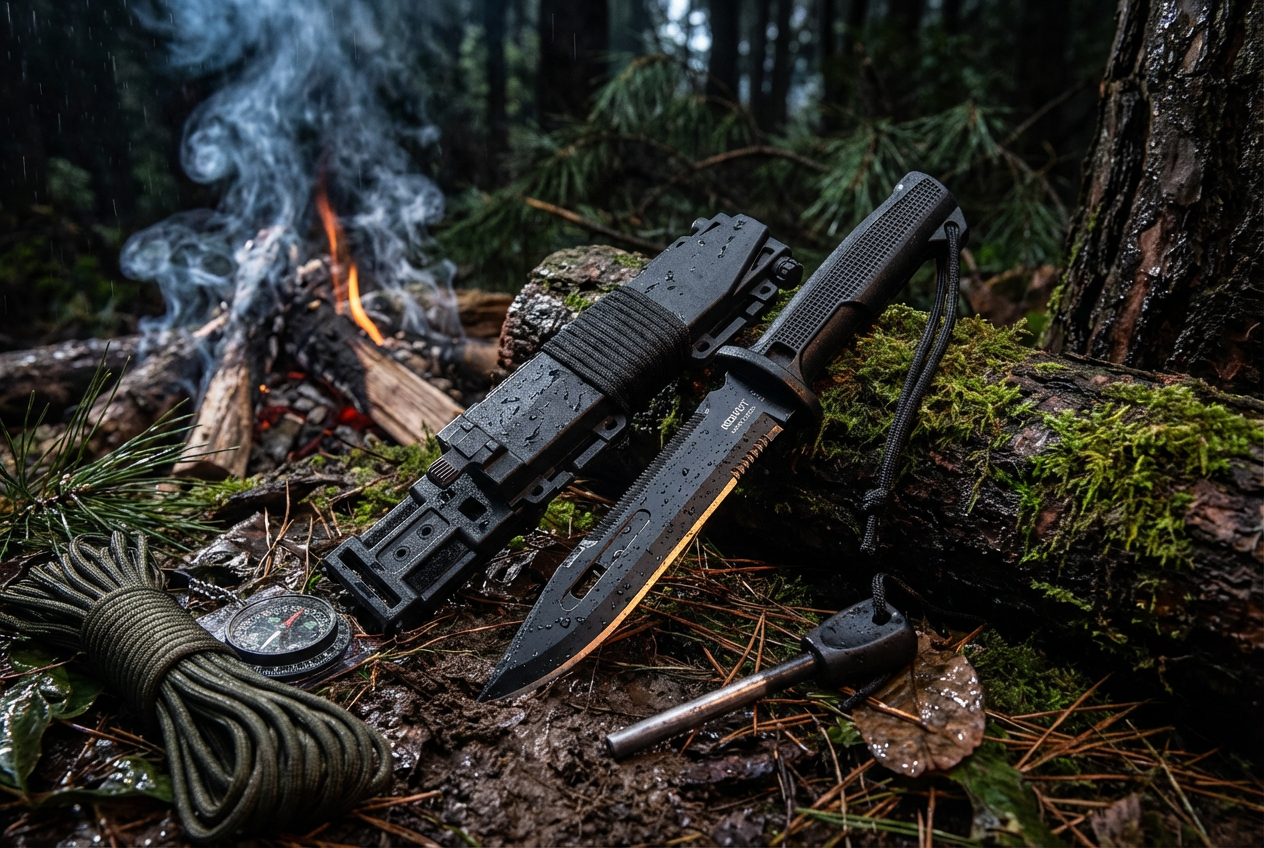
From Bayonet to Blade: The Evolution of the Viper Dagger
For decades, the M9 Bayonet has been the gold standard for U.S. military multi-purpose blades. Designed to mount on the end of a rifle while doubling as a field tool, it is an icon of utility. However, the NEXKUT Viper Dagger represents a distinct evolutionary shift.
While it retains the "chassis" of the M9, the Viper Dagger reconfigures the design DNA, moving away from a pure infantry bayonet to become a dedicated survival, fighting, and tactical knife.
Here is how the Viper Dagger modernizes the platform.
1. Blade Philosophy: Saw-Back vs. Combo Edge
The most immediate difference lies in how the blade is configured for utility.
The Classic M9: Features a prominent saw-back spine with large teeth. This was originally designed for pilots or infantry to saw through aluminum aircraft fuselages or wood. The actual cutting edge is usually plain.
The Viper Dagger: Removes the heavy saw teeth on the spine, replacing them with fine jimping (ridges) for thumb control. Instead, it moves the utility to the cutting edge, featuring aggressive serrations near the handle.
Why the change? In a modern survival or tactical scenario, cutting through nylon webbing, seatbelts, or thick rope is a more common necessity than sawing wood. The Viper prioritizes immediate cutting power over the slower sawing motion.
2. Carry Systems: Belt vs. Operator Configuration
The most telling difference is revealed in the Viper Dagger’s manual (as seen in the provided diagram). The classic M9 is almost exclusively carried on a standard belt or attached to a vest. The Viper Dagger, however, is designed for high-mobility deployment.
The Viper Dagger introduces a modular mounting system that transforms how the knife is worn:
Tactical Leg Strap System (Calf Carry): The manual explicitly details mounting the sheath to the lower leg, securing it around the "gastrocnemius bulge" (calf muscle). This "frogman" style carry keeps the knife accessible while crawling or when the upper body is encumbered by heavy gear.
Extended Drop-Leg: The system allows the knife to hang lower on the thigh, clearing body armor or plate carriers that often block access to standard belt-mounted knives.
3. The "Bayonet" Functionality
While the Viper Dagger retains the visual profile of a bayonet—including the distinct cross-guard and pommel shape—its identity has shifted.
The M9: Is defined by its ability to mount to the lug of an M16/M4 rifle. Its primary identity is a weapon attachment.
The Viper Dagger: Is defined as a standalone tool. While it likely retains the hardware to mount to a rifle, the marketing and design focus (especially the complex leg-carry straps) suggest it is meant to be kept in the hand or on the body, not left on a barrel.
4. Shared DNA
Both knives feature the iconic rectangular hole in the blade.
Both sheaths feature a steel lug (nub) at the tip.
By snapping the blade hole onto the sheath lug, the user creates a powerful pivot point to shear through barbed wire or fencing. This remains one of the most practical mechanical features ever put on a combat knife.
Verdict
The M9 Bayonet is a piece of general-issue history designed for the average soldier. The Viper Dagger is a specialized refinement. By swapping the saw-back for serrations and upgrading the carry system to a tactical leg-mount configuration, NEXKUT has turned a generalist bayonet into a specialist’s survival and combat tool.
Share:
Tuhon Rommel Tortal: From Pekiti-Tirsia Lineage to the PTK75 Tactical Design
Why You Need a Training Knife: The Importance of Muscle Memory